
How to Correctly Count Calories

by Kelly M

Chances are you’re doing it wrong. I’m sorry.

However, if you don’t care about the caloric information of anything ever, then feel free to just breeze on by and come back for cookies later! But for us humans who want to know this monumental secret I will most likely be referring back to for a long time, I recommend sticking around. Good thing I’m totally not biased or anything.

I cannot tell you how many questions/comments/emails/moderately panicked calls for help I get regarding this very topic. People (most often times very politely, so thank you) point out that my nutritional information is wrong, and that the actual stats are higher. It’s not wrong, folks. I just happen to know this little secret on how to correctly count calories, and I’m ready to let you all into the loop.

Ready? Okay. There’s this magical concept called a “net carb”, which is often used by people on diets such as Atkins or Paleo when carb counting, but it usually just ends there. I, on the other hand, have taken it a step further with the subsequent “net calorie. ”

First, some interesting/dorky background on biology and the composition of calories. The four major classifications of biological molecules are proteins, carbohydrates, lipids (fats), and nucleic acids (but we won’t be dealing with these today). You probably encounter the first three a lot in everyday life, especially on nutritional labels.

The calories in food come from proteins, carbohydrates, and fats. A gram of protein has 4 calories, a gram of carbohydrate has 4 calories, and a gram of fat has 9 calories. With a bit of simple math, you can verify that on any food label. Sometimes there is a discrepancy, and I always honor the caloric product I got after I plugged in my formula.

Let’s practice! This is a nutritional label from Regular Better ‘n Peanut Butter.
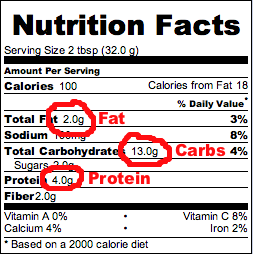
 

Does it work? Grams of protein x 4 (16) + grams of carb x 4 (52) + grams of fat x 9 (18) = 86 calories! Sometimes there are actually fewer calories than stated because the company overcompensates. That’s very respectable of the company, and a happy accident for us consumers!

However, it doesn’t always work like that. Here is a label for Fiber One Original.
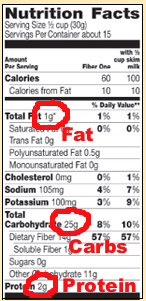
Let’s try it again: Grams of protein x 4 (8) + grams of carb x 4 (100) + grams of fat x 9 (9) = 117 calories. Hmm. That’s way off from the stated 60! Why is Fiber One allowed to say that? The FDA allows for a 20% discrepancy in food labeling, but this is much farther off than 20%. What gives?

So back to biology, there are many different kinds of carbohydrate molecules, and saying that they ALL have 4 calories a gram is simply incorrect. One of the reasons celery is such a low calorie food is that it contains a significant amount of cellulose, a fibrous carbohydrate that is indigestible by the human body. Therefore, if your body cannot break something down, it can’t absorb any energy from it. Calories that your body actually absorbs are called net calories.

You know how fiber is nature’s broom? That’s true too. Fiber “sweeps” through your system, cleaning out any unneeded particles and, because your body does not break fiber down, it goes out the other end. Your body does not absorb the calories from fiber either.

However, the traditional calorie counting formula does not take this into account. It would multiply ALL of the carbs in the product by four, instead of just the ones your body actually absorbs (total carbohydrates – dietary fiber). Behold, my modified and correct calorie counting formula!
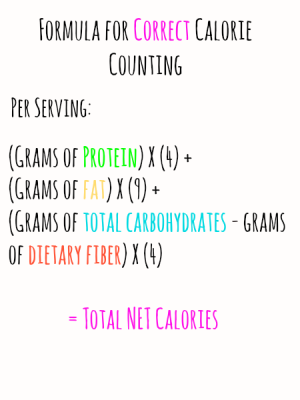
This concept is relatively widely accepted here in the US, but the FDA has not taken a stance on the subject. (For reference, here is a Hungry Girl article on this very topic.) In the meantime, this gives companies selling products in the United States free rein to take the initiative and use this concept to their advantage. Some companies, such as Fiber One, do just that.
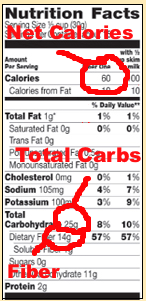
And now for your first application of your new favorite formula. Please contain your enthusiasm and hold your thunderous applause until the end. Grams of protein x 4 (8) + grams of fat x 9 (9) + grams of total carbohydrates – grams of fiber x 4 (44) = 61 calories (rounded down to 60 on the label). Whoa. Considering we thought the exact same serving of the exact same product had 117 calories just a minute ago, this is big. Huge.

Now you can start applying this to your daily life! Remember not to eat too much fiber as that is very hard on your GI track (and gives you plenty of gas; fun for all!), and do this, as well as everything else you do, in moderation.

I’m not going to lie… it still is pretty fun to do. You’re like Sherlock with a nutritional label. (I told you tweed would look awesome with your eyes!) Let’s take another look at the peanut butter label!
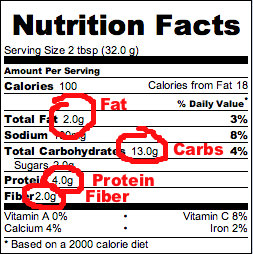
Grams of protein x 4 (16) + grams of fat x 9 (18) + grams of total carbohydrates – grams of fiber x 4 (44) = 78 calories. People. That’s 39 calories a tablespoon. Go forth and preach, grasshoppers.

I hope that clears things up! This is the method I use when calculating the nutritional information for all my recipes. Feel free to use it for whenever you want, but please slip my name into the conversation if at all possible… nudge, nudge. Spread the word! This is big!



What do you think? Do you have any nutrition questions or knowledge you’d like to share? Let the (friendly) discussion begin!

 

Leave a Comment

{ 23 comments… read them below or add one }

Kristy @ Southern In Law February 18, 2013 at 12:13 am

I love math, but I definitely don’t want my food to become a math problem – or a problem in itself! Our bodies aren’t calculators, even though our brains may be.

Reply

Lift, Sleep, Eat February 18, 2013 at 4:37 am

It’s great! Means more delicious food we can eat when we thought the portions we were eating equated to more calories! It pretty much means most veggies have 0 calories when their fibre content etc is taken into account.
Yummmyyy

Reply

Michelle @ Eat Move Balance February 18, 2013 at 7:24 am

I’m such a geek about all the numbers, too. Hello–I’m a high school math teacher. I live for it. :)

Question though: shouldn’t the last calculation be 44 calories (13-2 = 11, and then times by 4).

Great post–you made it so easy to follow! Thanks.

Reply

Jackie February 18, 2013 at 10:16 am

Hallelujah! My saving grace has been born! This clears alot of things up. Thanks so much Kelly!!!

Reply

Kelly M February 18, 2013 at 8:00 pm

Thank you so much Jackie, and I’m just glad I could help!

Reply

Erin Nichols February 18, 2013 at 11:10 am

Whoa…this is huge! I just calculated a few recipes. One was correct…giver or take one or two, and one was off by closer to 20 because of the fiber. This is very interesting and will make me look much harder at the nutrition labels…didn’t know I could look at them any more than I already do!

I hate people who nit-pick, but I did want to point out that when you look at the pb nutrition label the 2nd time at the end of your post, you calculated the protein as 4 grams times 2 (8) instead of 4 grams times 4. (16). It doesn’t make a big difference, but… :)

Thanks for sharing this! This gives me a great deal to thing about!

Reply

Chris February 18, 2013 at 11:39 am

Your efforts to count correctly are commendable, but please note you are not making the distinction between soluble and insoluble fiber. While it is true insoluble fiber does not get absorbed at all, soluble fiber ferments in the GI tract and contributes an effective 2 calories/gram. This is confounded by the fact that nutrition labels often do not break down this distinction.

http://en.wikipedia.org/wiki/Dietary_fiber#Fiber_and_calories

Some recommended deeper reading into the history of calorie measurement and how the 9/4/4 numbers came to be: http://ajcn.nutrition.org/content/79/5/899S.long#ref-28

Reply

Kae February 18, 2013 at 1:56 pm

I am taking a nutrition class right now and according to our teacher, the FDA hasn’t taken a stance on fiber yet because people are still debating how fiber is digested. Evidently some people think soluble and insoluble fiber are digested differently and that you can get ‘some’ calories from fiber. Some scientists have suggested calculating 2 calories per gram of fiber just to be safe, but NO ONE AGREES ON ANYTHING (as usual). So I’m just going to take your advice and not count fiber and get to eat more ;)

Reply

Mary February 18, 2013 at 5:59 pm

wow, thanks! i didn’t think there was any more to calorie counting than just reading off the nutrition label, thanks for the info!

Reply

Kelly M February 18, 2013 at 7:59 pm

I hope I could help!

Reply

Bek @ Crave February 18, 2013 at 6:57 pm

Very interesting- definitely gave me something to consider :)

Reply

Kelly M February 18, 2013 at 8:36 pm

Why thank you, Bek dear. ;)

Reply

Jun February 19, 2013 at 6:11 am

Wow, this post is truly an eye-opener! I think it’s amazing how you actually stop and look deeper into this matter, then make the effort to share with us such a great piece of knowledge! Thanks!

Don’t worry, with or without cookies, I still love reading your blog! :)

Reply

alek February 21, 2013 at 6:55 pm

Im sorry to be the only not so nice comment here BUT I knew this stuff last year at your age and it is great that you are educating and helping others but truly at our age we don’t need to worry about this kind of stuff AT ALL! At our age the correct way to count calories is to NOT count calories. This is just my opinion and I hope this doesn’t offend you but if you want to talk feel free to check out my blog and email me!

Reply

Alyssa March 6, 2013 at 12:20 pm

agree. agree. agree. the best way to do whatever you find calorie counting useful for (weight loss/gain, muscle building/cutting, overall health) is to simply AVOID counting calories.
to kelly, and her devoted readers:
eat real, nutrient-dense foods that supply your body with what it needs. deprivation only sets you up for failure. i encourage you to learn what intuitive eating is.
counting calories very easily turns obsessive, ESPECIALLY particularly with someone, like you, kelly, who admits to a history with weight loss through disordered eating. now, tell me, why would you continue to promote something that even you deemed incredibly obsessive and unhealthy? it’s already one thing that your blog inculcates the knowledge of every single calorie in each recipe. it’s another to make a post labeling it as a “fun” thing to do. it’s not fun. it’s an obsession. it’s a disorder.

Reply

Kelly M March 16, 2013 at 10:04 pm

Hi Alek and Alyssa. I do appreciate your input, but please let me explain my point of view.

Alek, I admire your journey. I do. Overcoming what you have overcome and knowing what you do at our age is great. As for me and counting calories, I put on weight very easily. I have to be aware of what I’m eating if I want to simply maintain my weight. When I stopped counting calories entirely back in January 2012, I gained 9 pounds in one month. I do exercise regularly, but this is just a reality for me. Now, I approximate calories every once in awhile to see where I am, but I certainly don’t do it everyday (THAT is neurotic and unhealthy). I would like to talk with you at some point, and no, I am not offended.

Alyssa, I do appreciate your input, but please allow me to defend myself. Please do not accuse me of having an eating disorder. It is not true, (I have seen multiple nutritional/medical experts who agree with this.) If I don’t post calories counts, (I didn’t for about the first year, please look in my archives) I will get many comments and emails asking for them. I still have to go through old recipes and add calorie counts due to popular demand. When I do post the calorie counts, people leave comments asking if they’re wrong. Then I have to leave a long response on why they’re not wrong. Soto save time (and inevitably sleep) I wrote a post to explain my calculation methods. When I publish the post, I am accused of having an eating disorder. I don’t. I’m just trying to answer questions and make it easier for everyone. Thanks, and enjoy the rest of your weekend!

Reply

Alek March 25, 2013 at 8:59 am

Thank you for replying Kelly! I guess if that is your story I understand. I am sorry that you gain weight so easily but by doing exercise especially lifting or HIIT you can try to help your metabolism so that doesn’t happen. I am happy I didn’t offend you but I still think being your age you should try to just live life without all the stresses of a blog. Even if you enjoy writing you have to admit you feel an obligation to write and some times you don’t always feel like it. At your age just have fun before high school actually forces you some stress. Make good friends to keep over summer and into high school. A blog may seem to be a friend and bring you friends but friends in person are also important.

Reply

Megan S. March 2, 2013 at 2:35 pm

Crazy! I had never seen anything like that before- very neat and interesting :)

Reply

Charlotte March 7, 2013 at 10:17 pm

Thank you for this! I just found out that the slice of pumpernickel i was munching on only contained 80 calories, rather than the 110 it says on the pack! Bonus :p

I posted your discovery on my blog, referencing back to you, of course :)
Here’s the link; http://eyelashetc.tumblr.com/post/44748912699/youre-counting-calories-wrong-i-just-found

Reply

Maggie Hartley March 17, 2013 at 12:28 pm

I love the formula but I have to ask, what about sugar? Doesn’t that count as a carb?

Reply

Kelly M March 25, 2013 at 1:24 pm

Hi Maggie! Yes, sugar does count as a carb. It is included within the carb count though, so you don’t have to account for it again. For example, if something has 7 grams of carb, but it has 2 grams of fiber and 2 grams of sugar, you would just subtract the fiber to get 5 grams of carb (5 x 4 = 20 calories). Hope this helps!

Reply

Katie March 21, 2013 at 8:15 pm

Ermagerd, I think I love you! I knew fiber was good for me, but I had no idea I could use it for subtraction purposes. Thank you!

Reply

Kelly M March 23, 2013 at 11:12 pm

Thank you so much Katie! I just hope I could help.

Reply

{ 1 trackback }

Previous post:

Next post: